-
 +86 155 5799 4552
-
 info@carbon-tx.com
-
 Blue Carbon Neutral Industrial Park,Tai'an City, Shandong Province,China
+86 155 5799 4552
info@carbon-tx.com
Blue Carbon Neutral Industrial Park,Tai'an City, Shandong Province,China


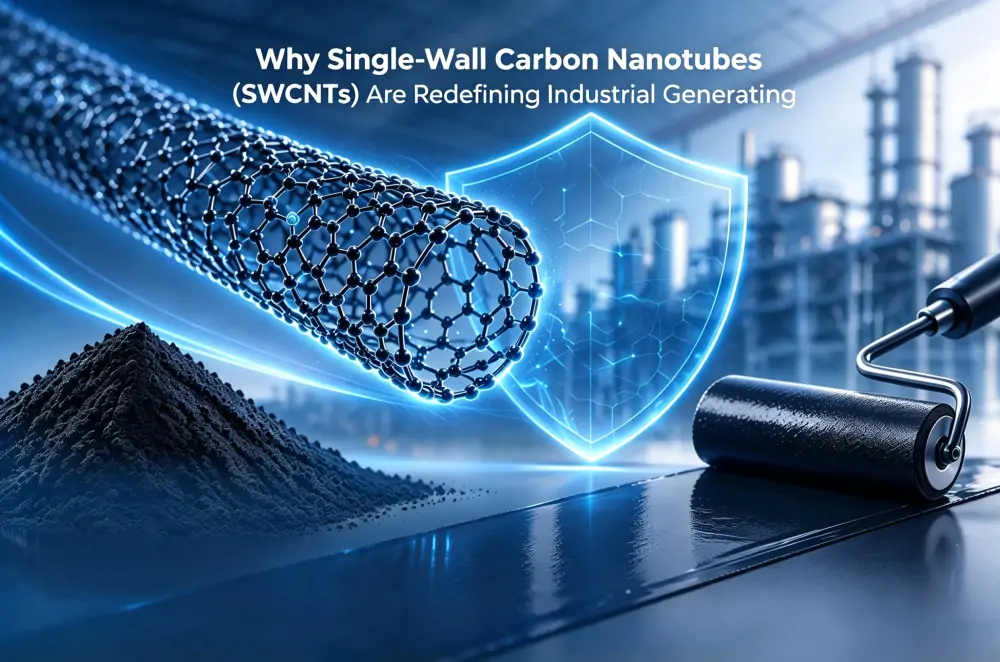
For decades, formulators of conductive and antistatic coatings have been locked into a frustrating set of tradeoffs. Whether for ESD floor coatings, semiconductor clean-rooms, or marine anti-corrosion primers, achieving conductivity often meant sacrificing mechanical integrity and aesthetic flexibility.
Thanks to advanced nanomaterials, that paradigm is shifting. Here is why single-wall carbon nanotubes (SWCNTs) are rapidly becoming the core additive for next-generation industrial coatings.
Before the adoption of nanomaterials, achieving conductivity in coatings typically involved three main compromises:
High Carbon Black Loadings: To reach the percolation threshold, high doses of carbon black were required. This results in brittle films, ruined adhesion, and restricts formulations to black or dark colors only.
Migratory Antistatic Agents: These agents rely on migrating to the surface to attract moisture. They wear off over time, fail in low-humidity environments, and can contaminate sensitive surfaces.
Compromised Mechanical Strength: Adding traditional conductive fillers often degrades the weatherability and scratch resistance of the base coating.
SWCNTs are one-dimensional tubular carbon materials with an ultra-high aspect ratio. Because of this unique structure, they require a fraction of the dosage to form a highly efficient, permanent 3D conductive network.
This isn't just an incremental improvement—it is a structural step-change:
Ultra-Low Loading: Effective at just 0.05–0.3 wt%, which is 1/30 to 1/50 the dosage of traditional carbon black.
Color & Transparency: SWCNTs unlock light-colored, tinted, and even fully transparent conductive coatings, an impossible feat with traditional fillers.
Preserved & Enhanced Mechanics: Instead of weakening the film, SWCNTs preserve and even enhance base coating adhesion, scratch resistance, crack resistance, and weatherability.
System Compatibility: They are drop-in compatible with water-based, solvent-based, epoxy, PU, and fluoropolymer systems.
While SWCNTs offer incredible performance, they are notoriously difficult to disperse due to strong van der Waals forces. At Carbon Search New Materials, we address this formulation challenge by providing a complete, ready-to-use SWCNT portfolio engineered for every coating system:
Aqueous SWCNT Dispersions: Optimized for water-borne coatings.
Oil-based / NMP SWCNT Dispersions: Designed for solvent-borne and epoxy systems.
Surface-functionalized SWCNT Powders: Available for custom formulation development and specific chemical grafting.
From automotive conductive primers to advanced ESD systems, the transition to SWCNTs is no longer just a lab experiment—it is a competitive advantage.
Contact our technical team at Carbon Search today to explore tailored solutions and request your sample.
 Contact

 English
 Chinese