-
 +86 155 5799 4552
-
 info@carbon-tx.com
-
 Blue Carbon Neutral Industrial Park,Tai'an City, Shandong Province,China
+86 155 5799 4552
info@carbon-tx.com
Blue Carbon Neutral Industrial Park,Tai'an City, Shandong Province,China


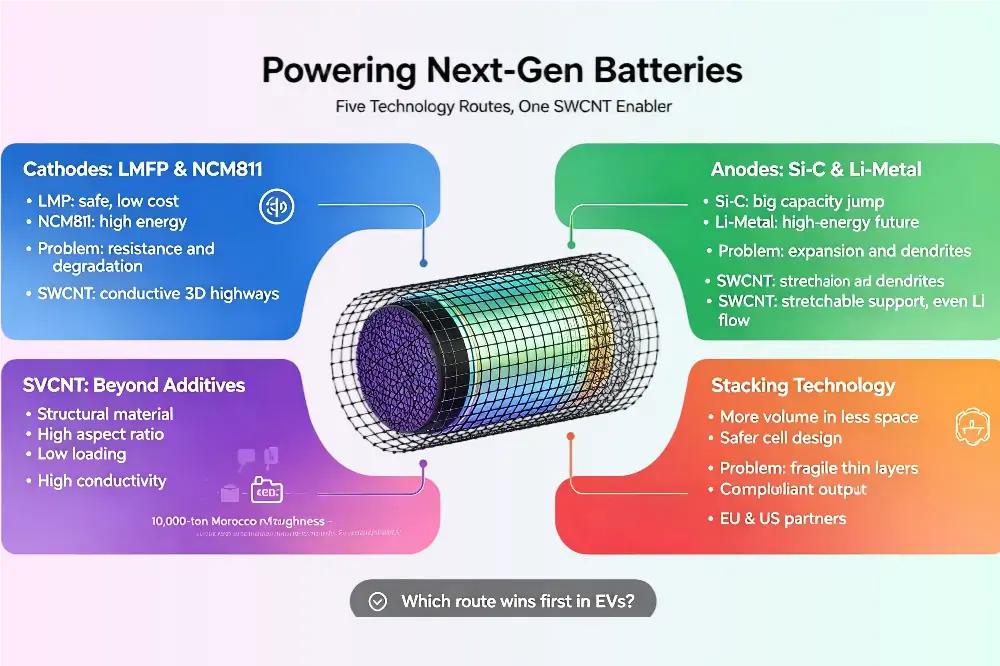
The race for higher energy density, faster charging, and lower costs in the EV market is accelerating. As battery R&D pushes the boundaries of chemistry and engineering, five key technologies have emerged as the new core of next-generation energy storage.
However, each of these technologies faces severe material bottlenecks. Here is how ultra-low loading single-walled carbon nanotubes (SWCNTs) from Carbon Search New Materials make them commercially viable.
Battery manufacturers are actively shifting towards LMFP (Lithium Manganese Iron Phosphate) for its superior thermal stability and lower cost, and NCM811 to push the limits of energy density.
The Bottleneck: LMFP inherently suffers from poor electrical conductivity, while NCM811 struggles with structural instability at high voltages, leading to capacity fade.
The SWCNT Solution: At a remarkably low dosage of just 0.1 wt%, SWCNTs form a continuous, microscopic 3D conductive network. This drastically slashes Direct Current Resistance (DCR) and stabilizes the electrode structure, enabling extreme fast charging without degrading the cathode.
To achieve the next leap in capacity, the industry is moving toward Silicon-Carbon (Si-C) anodes (offering 10x the capacity of graphite) and Lithium-Metal anodes, the "holy grail" for solid-state batteries.
The Bottleneck: Silicon suffers from a massive ~300% volume expansion during cycling, causing the particles to pulverize. Lithium-metal anodes face fatal dendrite growth, which poses severe safety risks.
The SWCNT Solution: SWCNTs are highly elastic. They expand and contract with the silicon particles, acting as a flexible binder that prevents pulverization and maintains electrical contact. For Li-metal anodes, the massive specific surface area of SWCNTs provides uniform nucleation sites, effectively suppressing dendrite formation.
Stacking technology is rapidly replacing traditional winding processes because it maximizes space utilization for higher volumetric density and better safety profiles.
The Bottleneck: Stacking requires ultra-thin electrodes, which become brittle and prone to micro-shorts or fracturing during high-speed manufacturing.
The SWCNT Solution: Our SWCNT conductive slurries provide exceptional mechanical toughness and adhesion. This keeps ultra-thin electrodes flexible, robust, and highly resilient during the high-speed stacking process, significantly reducing scrap rates.
SWCNTs are no longer just conductive additives; they are structural materials. With an aspect ratio of >10,000, they deliver extreme electrical conductivity and mechanical reinforcement with virtually zero weight penalty to the final cell.
Technology must be backed by scalable supply chains. At Carbon Search New Materials, we are proud to support global battery manufacturers with a compliant, 10,000-ton supply base in Morocco. This strategic location allows us to seamlessly serve and support EU and US Gigafactories with localized, tariff-compliant material supply.
Which of these technical routes will dominate the EV market first? Our engineering team is ready to discuss your specific battery roadmap and provide lab-scale samples for your A/B testing.
Contact us today to learn more about our advanced SWCNT slurry and powder solutions for battery applications.
 Contact

 English
 Chinese