Build efficient conductive & reinforcing network at ultra-low dosage to boost cathode and anode performance
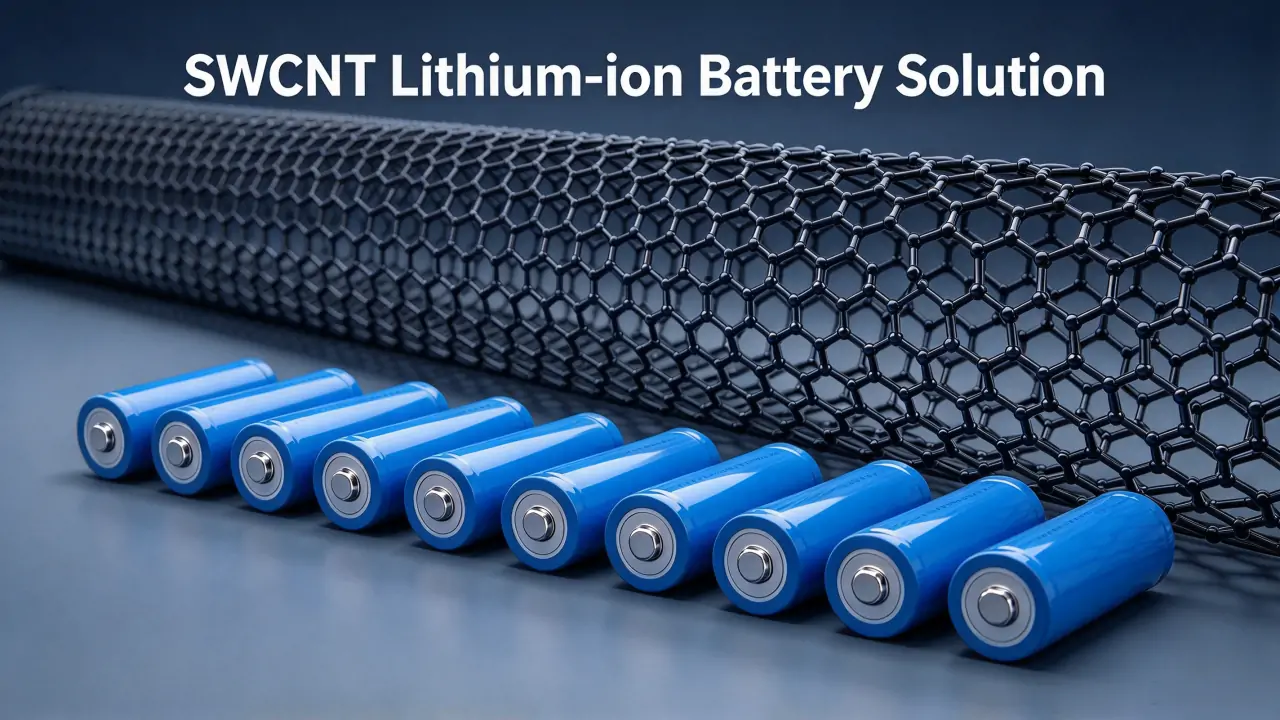
Single-walled carbon nanotubes (SWCNTs) feature an ultra-high aspect ratio. Under the same mass, the quantity of SWCNTs is more than 10 times that of multi-walled carbon nanotubes (MWCNTs). Only an extremely low loading is required to form a continuous conductive and reinforcing network, which greatly improves discharge power, energy density, electrode adhesion and safety performance of lithium-ion batteries, compatible with both cathode and silicon-based anode systems.
Core Advantages
✅ Ultra-low dosage: Ultra-high aspect ratio enables long-range interconnected 3D conductive network without occupying the space of active materials, preserving high energy density
✅ Dual function: Excellent electrical conductivity plus mechanical toughness, both electron transport and electrode structural reinforcement
✅ Dual-system compatibility: Customized performance improvement for cathode materials and silicon-based anodes
✅ Comprehensive performance promotion: Rate capability, cycle life, electrode consistency, thermal stability and cell safety are improved simultaneously
✅ Manufacturing friendly: Pre-dispersed SWCNT slurry fits existing lithium-ion battery slurry mixing, coating and calendaring lines with low modification cost
1. Application of SWCNTs in Lithium-ion Battery Cathode
-
Improve structural stability With high mechanical strength and thermal stability, SWCNTs buffer volume expansion/contraction during charge and discharge, suppress structural degradation and extend cycle life.
-
Increase specific surface area Large specific surface area provides abundant active reaction sites, accelerates lithium-ion diffusion and interfacial reaction for better rate performance.
-
Enhance cycling stability SWCNTs restrain active particles and prevent detachment or structural collapse during cycles, stabilizing capacity output.
-
Promote uniform dispersion SWCNTs act as dispersion aids to homogenize cathode active materials, reduce particle agglomeration and improve batch consistency of electrodes.
-
Construct 3D conductive network Form interconnected conductive pathways between particles to reduce internal resistance and accelerate ion & electron transfer for higher discharge power.
-
Boost energy density Optimize specific capacity utilization of cathode materials to achieve higher cell energy density.
-
Improve thermal management Good thermal conductivity facilitates heat transfer inside cells and avoids local hotspots.
-
Raise thermal safety Improve the thermal stability of cathode materials and reduce thermal runaway risk under overcharge or high-temperature conditions.
-
Stable interfacial CEI film Facilitate the formation of stable CEI film between cathode and electrolyte, stabilizing interfacial impedance and improving cycle performance and safety.
2. Application of SWCNTs in Lithium-ion Battery Anode (especially silicon-based anode)
-
Higher electrical conductivity Superior intrinsic conductivity connects discrete active particles, reduces internal resistance and realizes high-rate charge & discharge.
-
Extra lithium storage sites Large specific surface area offers more sites for lithium-ion intercalation to release higher capacity.
-
Improve cycle stability Flexible interconnected network accommodates huge volume change of silicon-based anode, preventing particle pulverization and keeping conductive pathways intact.
-
Homogeneous lithiation Guide uniform lithium distribution inside silicon anode, avoid local over-lithiation or under-lithiation and retain capacity steadily.
-
Better safety performance Optimize heat dissipation, reduce heat accumulation and lower the risk of thermal runaway.
-
Improve initial Coulombic efficiency Optimize the interface of silicon anode and lift the first-cycle efficiency.
Comparison Table
|
Item |
Lithium-ion battery with SWCNT conductive additive |
Lithium-ion battery with Carbon Black / MWCNT additive |
|
Quantity under same mass |
Over 10 times of MWCNT |
Limited quantity, short segmented conductive units |
|
Loading dosage |
Ultra-low: 0.02–0.3 wt% |
Higher dosage: 1–4 wt% |
|
Conductive network |
Long-range continuous network, hard to disconnect in cycles |
Short contact conduction, easy to lose connection after cycling |
|
Mechanical reinforcement |
Strong, buffer volume expansion of cathode & anode |
Weak reinforcing effect |
|
Impact on energy density |
Negligible negative impact due to ultra-low loading |
High loading occupies active material volume and sacrifices energy density |
|
Electrode adhesion |
Significantly improve electrode adhesion and reduce material peeling |
Limited improvement |
|
Thermal conductivity & safety |
Good heat conduction, better thermal management and thermal stability |
Poor thermal conductivity |
|
Typical use case |
Fast-charging power battery, silicon anode high-energy battery, long-cycle energy storage battery |
Conventional low-rate lithium-ion batteries |
Application Fields
-
EV power batteries, fast-charging traction batteries
-
Energy storage lithium batteries, residential & commercial ESS
-
3C fast-charge batteries, drone, power tool batteries
-
High-energy-density lithium batteries with silicon-based anode
Specification & Delivery
-
SWCNT slurry: Cathode-grade conductive slurry, pre-dispersed conductive slurry for silicon anode
-
Custom formulation: High-rate grade, long-cycle grade, high-energy-density silicon anode grade
-
Technical service: Electrode & cell prototyping, electrochemical characterization (rate, cycle, thermal safety test), third-party test reports available
 +86 155 5799 4552
 info@carbon-tx.com
 Blue Carbon Neutral Industrial Park,Tai'an City, Shandong Province,China


 Contact

 English
 Chinese